Fan demand with strong policy
Originally posted June, 2024
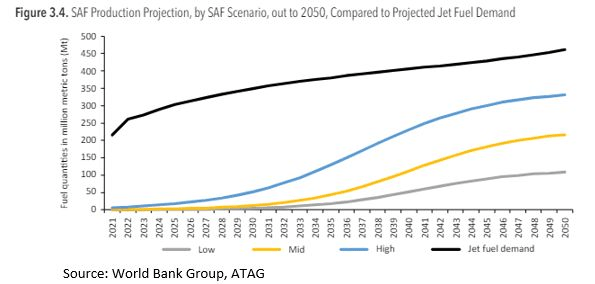
Future demand for sustainable aviation fuel is highly uncertain given its dependancy on (among other things) national emissions plans, supportive policy, and technological development. By 2050, IRENA estimates demand of >100 billion litres each year to achieve a 50% emissions reduction, 200 billion litres for an accelerated, 1.5 degree scenario. IATA estimates ~450 billion litres in the same period. There are a dozen other models all with varying figures. The figure though is irrelevant. What we need to observe is the rate of scale, along with sufficient policy to ensure commercial viability.
Policy: Policy will be the formative piece to reduce cost relative to conventional fuels. It also will determine what feedstocks and production pathways are considered sustainable. A dominant challenge in the biofuel world is ensuring that the feedstock is not impeding upon food security, or contributing to further deforestation to meet forecast demand.
Current biojet fuel costs are 120%-700% higher than conventional jet fuels1 and only 38% of existing policies provide monetary incentives to SAF producers2. In the EU, the RefuelEU legislation sets out guidelines for the aviation industry, outlining the scope of eligible fuels (emphasising non-organic and synthetic fuels) and adoption targets by 2025 and 2030 – however, more needs to be done to support production and pricing. In the US, the Inflation Reduction Act offers a US$1.25 credit for each gallon of sustainable aviation fuel that qualifies and that reduces lifecycle emissions by 50%. However, whilst the US targets price, its definition of a sustainable fuel is less stringent, allowing for corn ethanol and vegetable oils that could actually increase emissions and/or divert arable land away from food production3.


Commitments: Unclear, uncontracted demand is a key uncertainty for the industry. Thus far, most production and demand has come from developed markets. The IEA expects biojet fuel demand in emerging markets to reach ~1 billion litres by 2028 (from a near-zero baseline), ~4x less than developed markets. Pleasingly, countries like Indonesia are on the precipice of publishing a SAF roadmap (expected end of June 2024) that should bolster supply and stimulate demand in the region. India too, is eyeing a greater use of SAF in the coming years.
- IRENA, IEA, IATA ↩︎
- https://www.sciencedirect.com/science/article/abs/pii/S095965262400920X ↩︎
- World Resources Institute ↩︎
 Euthymia
Leave a comment