I have a strong preference to look at more long-term macro trends because I see shorter-term current affairs as distractive, typically. But what’s life without making a few exceptions.
For much of 2024, there has been a growing chorus of individuals calling for nuclear power in Australia. I have no issue with nuclear, it makes sense for a lot of countries. But for a country that is blessed with abundant natural resources, flat land (much of which is not utilised), and a rapidly growing renewables market (35% of generation nationally) – nuclear is a (costly) distraction for Australia.
Before I get into the weeds I think it critical to outline what I think the objective of this energy infrastructure buildout is. Establish energy security, reduce emissions, lower electricity costs, and drive national productivity.
The tale of nuclear reactors
Nuclear has, for most of its history, been a rather safe energy source. For that reason it provides ~10% of global electricity generation, ~20% in developed economies, and has avoided 70 Gt of carbon emissions over the last 50 years[1]. Its benefits are tangible and meaningful.
We also know it has had its fair share of set backs, particularly since the ’80s. One issue with nuclear (fission) power is that it’s an immensely safe resource, until it’s not. But whether we’re talking about Chernobly or Fukushima – both were attributed to operational, design, and governance flaws – each disaster was undoubtedly preventable [2] [3]. To noones surprise, these events have derailed capacity building globally.
Cost and time are the other challenges developers face with nuclear projects. Cost overruns and construction delays are a common occurrence given the complexity of the project (mean cost overrun of 120% v solar at 1%) [4], whilst the average construction time between 1976 and 2009 was 92 months (7.7 years).
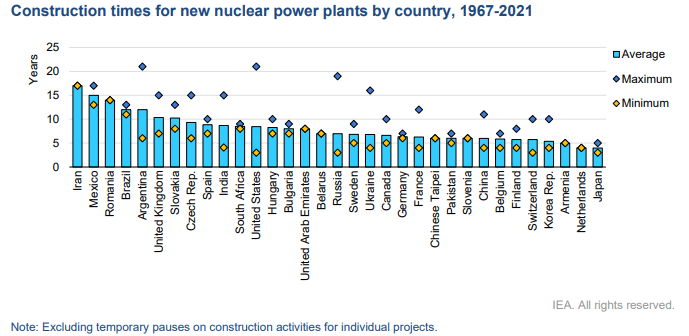
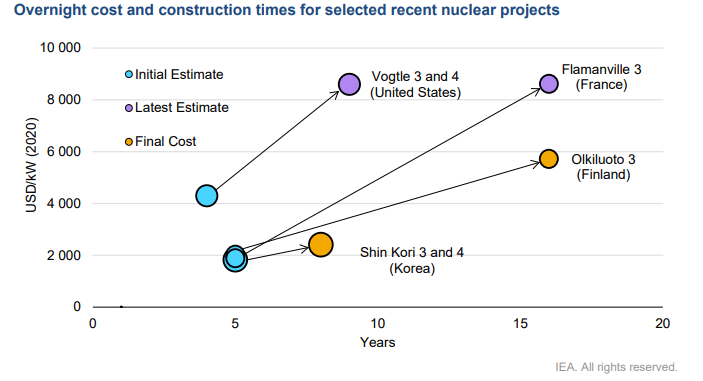
The other elephant in the room is that the aforementioned figures are based in countries that have an established nuclear infrastructure. Australia does not. Meaning that almost all components of the value chain would need to be imported and/or created from scratch. Estimated cost? According to the CSIRO, about AU$18 billion…for one 1GW project (for reference 1GW of solar in Australia would cost between ~AU$650 million to AU$2 billion) [5].
If we just pause here and question what we are actually trying to achieve, one would think that using a mental model like Occams Razor would be rather helpful – opt for the simplest (and often most effective) solution to achieve the intended outcome.
The numbers
A few years ago the Massachusetts Institute of Technology (“MIT”) published a paper on the source of cost overruns in nuclear power plants, based on five decades of cost modelling in the USA. What they found was interesting:
1) subsequent plants often cost more than, not less, than the initial plant
2) soft costs (i.e. process changes) had material cost implications because of last-minute design changes [6].
First I wanted to address the omnipotent Small Modular Reactor (“SMR”). I am quite bullish on the technology, and like many who are concerned about declining rates of productivity am hopeful this reaches commercial scale sooner rather than later. But we are not there yet. Nevertheless, many tout that the humble SMR, that is a smaller reactor (in physical size and capacity, <300MW), more modular design, better safety mechanisms, is some sort of panacea to providing clean and constant power.
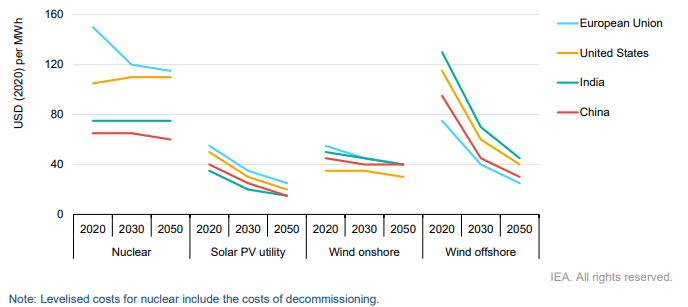
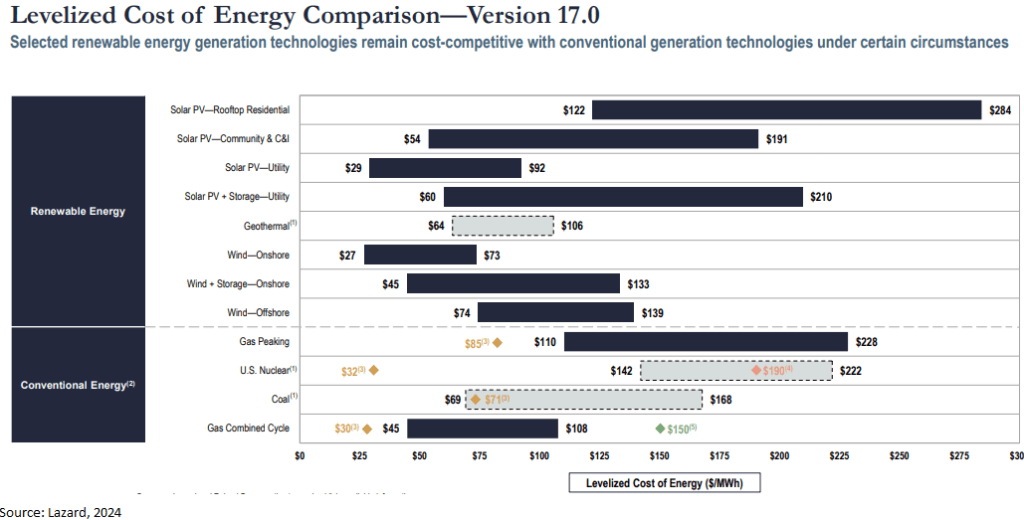
Second, the immense figures. Frontier Economics (mandated by the Coalition Government) place a AU$10b/GW figure (excluding financing), but that would seem conservative when benchmarked against the IEA (AU$14b/GW) and IEEFA (AU$15-AU$28b/GW). The IEAs figure would translate to a levelised cost of electricity (“LCOE”) in developed nations of ~US$110/MWh (noting India and China achieve figures closer to US$80/MWh), ~25-30% more than solar with storage. Considering capital costs contribute ~60% to capital costs for these projects, I do also wonder about the appetite to finance a project like this in Australia – I imagine LCOE would be 20%+ higher, would need government sponsorship to cap discount rates, and funding would need to be crystal clear to repay debt and meet ongoing O&M costs.
The opportunity for innovation
In 1928 the British advertised Australia as the “land of opportunity” in a bid to increase migration and encourage British settlement across the empire. That maxim has held true for severals decades, whether that be in the form of Australia’s housing boom, a robust and dominant resource mining industry, or our ability to export educational services across the globe.
But I would argue that for far too long we have missed swathes of opportunity to capitalise upon these opportunities, whether out of misguided policy or complacency. Shfiting geopolitics, constrained net immigration, and less liberalised policy will mean Australia too must adapt.
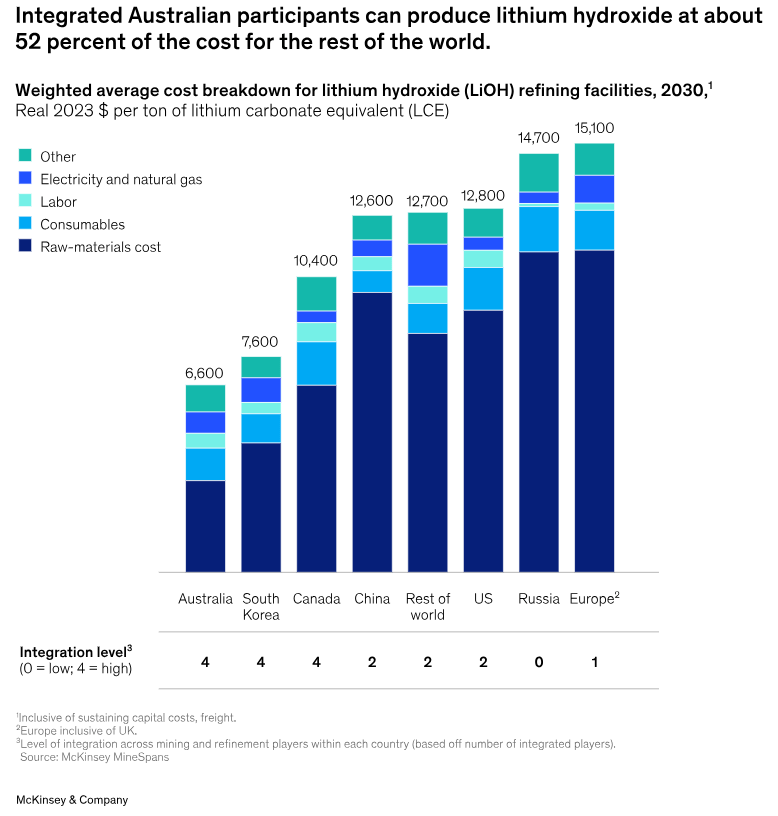
Mining is a clear example. For decades we have exported (primarily to China) various materials, iron ore, lithium, bauxite, etc, but have failed to establish a processing industry. Australia accounts for 43% of global lithium extraction but has only recently started to refine these materials domestically. The opportunity? Potentially US$10b when/if lithium prices return to a more historical average of ~US$24 per kg (internal rate of return, “IRR”, of upto 36%). Even in the current scenario where oversupply has dessimated production plans and pricing to ~US$15 per kg, IRRs may still reach 12 to 21% [7].
Energy generation presents yet another front where Australia possesses the potential to become a net renewables exporter and bolster partnerships with regional stakeholders. Importantly, cheap, clean, and reliable energy will (finally) allow (as I think) one of the most developed nations with the most underdeveloped talent/productivity to stoke the fire of innovation and create a meaningful value-add services industry that would allow for stronger wage growth and productivity.
If we truly built out the planned 13GW of nuclear capacity, that would cost us, even by Frontier’s figures at least $130 billion + financing costs. Which, if we assume a
If nuclear were to become a major part of the energy mix we would destabilise energy security, increase electricity costs, and (most probably) see emissions increase (due to cost overruns and delays + shelved renewables capacity). In doing so we would hinder the nations growth trajectory and, further a budget deficit that currently stands at 2.6% of GDP [8].
Or maybe we should just allocate that capital to other, more accretive technologies and finally get on with it…
Challenging my own bias
I was about to publish this before I thought I should take a look at my own bias. So I thought, what motivation might there be to push ahead with nuclear:
1) developing nuclear in Australia may further scientific and industrial innovation
2) Australia can catch up to other nuclear-oriented economies (USA, France, Japan, China, Russia)
3) nuclear energy presents a path to developing knowledge on defence-related applications
There are valid concerns and reasons behind each of those that deserve their own evaluation. But at a glance I would say chasing a nuclear path also does a disservice to already established value chains that Australia is either naturally exposed to or has already laid the groundwork for – that could be better explored. Whether that is minerals processing (as above), clean energy exports, or even artifical intelligence and robotics development. What do each of those require? Cheap, abundant energy.
References
[1] International Energy Agency, 2023
[2] Nuclear Energy Agency; International Atomic Energy Agency
[3] Carnegie Endowment for International Peace; Harvard University (2015)
[4] Flyvbjerg Database, 2023
[5] Based on construction costs for North Queensland Energy Renewable Park, FRV Australia, and Wandoan South Polar Project
[6] MIT, Sources of Cost Overrun in Nuclear Power Plan Construction, 2020
[7] McKinsey, 2023
[8] Australian Parliamentary Budget Office, 2024
 Euthymia
Leave a comment